
Amazon FBA vs FBM: Complete Guide for Sellers (2026)
Introduction
If you're planning to start selling on Amazon, one of the most important decisions you'll make is selecting the right fulfillment method. Amazon offers two primary fulfillment models:
- Amazon FBA (Fulfillment by Amazon)
- Amazon FBM (Fulfillment by Merchant)
Both options allow you to sell products on Amazon, but they differ significantly in how inventory is stored, orders are fulfilled, shipping is managed, and customer service is handled.
In this guide, we'll explore both models in detail, compare their advantages and disadvantages, and help you determine which is best for your business.
What is Amazon FBA?
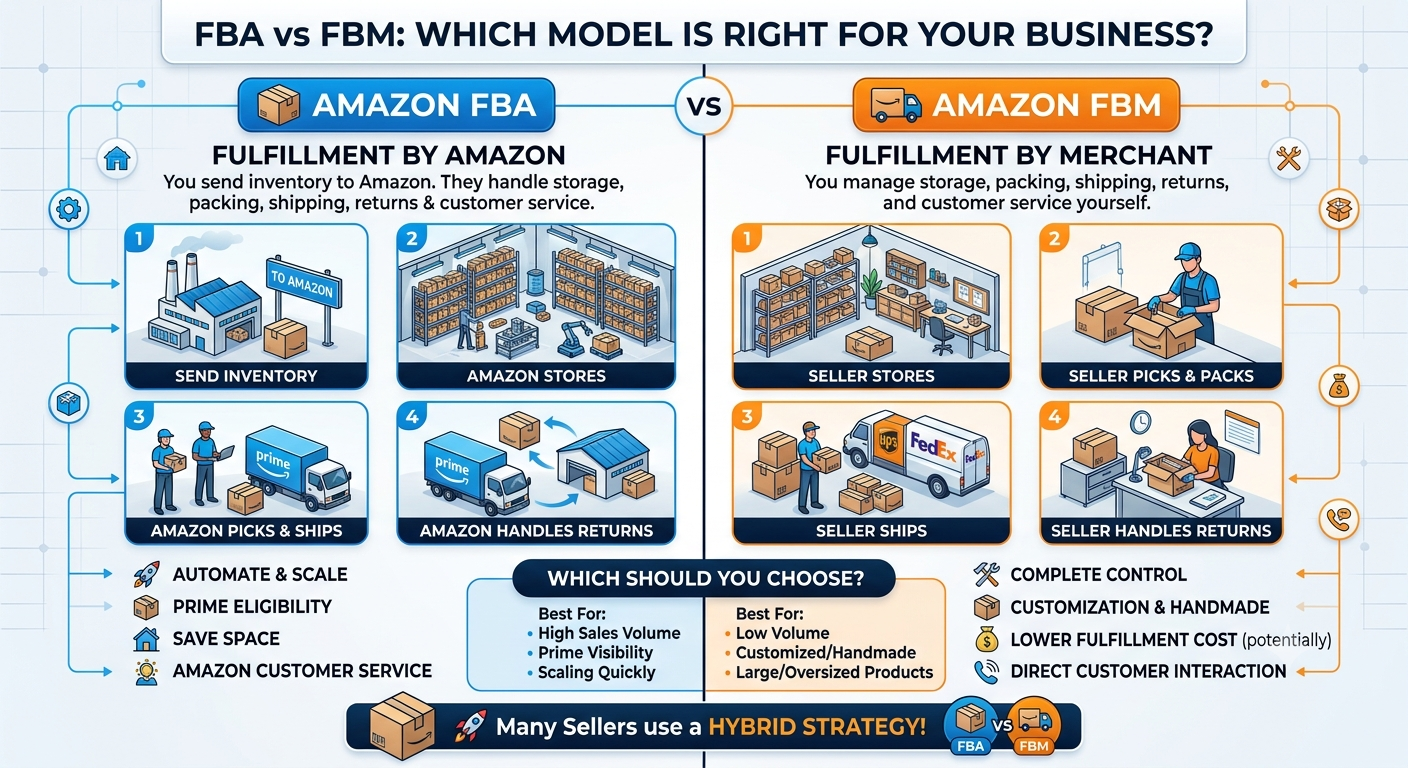
Amazon FBA (Fulfillment by Amazon) is a service where sellers send their inventory to Amazon's fulfillment centers. Once inventory is received, Amazon manages nearly every aspect of order fulfillment.
Amazon handles:
- Inventory storage
- Picking products
- Packing orders
- Shipping
- Customer support
- Returns and refunds
This allows sellers to focus on sourcing products, marketing, and growing their business.
How Amazon FBA Works
Step 1: Source Your Products
Purchase or manufacture products you want to sell.
Step 2: Create Product Listings
List your products in Amazon Seller Central.
Step 3: Ship Inventory to Amazon
Amazon provides warehouse addresses and shipping labels.
Step 4: Amazon Stores Your Inventory
Products are stored safely in Amazon fulfillment centers.
Step 5: Customer Places an Order
Amazon automatically processes the order.
Step 6: Amazon Picks, Packs, and Ships
The customer receives the product quickly, often with Prime delivery.
Step 7: Amazon Handles Customer Service
Returns, refunds, and customer inquiries are managed by Amazon.
Example of Amazon FBA
Suppose you sell Bluetooth speakers.
You manufacture 2,000 units and ship them to Amazon's warehouse.
A customer orders one speaker.
Amazon automatically:
- Finds the item
- Packs it professionally
- Ships it within one day (for Prime customers)
- Handles tracking
- Processes any returns if needed
You receive payment after Amazon deducts its fulfillment and storage fees.
Advantages of Amazon FBA
Fast Prime Shipping
Products become eligible for Amazon Prime, increasing customer trust and conversion rates.
Better Customer Experience
Amazon provides professional packaging, fast shipping, and reliable customer support.
Business Scalability
Whether you receive 20 or 20,000 orders daily, Amazon can manage the fulfillment process efficiently.
Buy Box Advantage
FBA sellers often have a stronger chance of winning the Buy Box due to Amazon's fulfillment performance.
Disadvantages of Amazon FBA
- Storage fees
- Fulfillment fees
- Long-term storage charges
- Less control over packaging and branding
- Inventory planning is essential to avoid extra costs
What is Amazon FBM?
Amazon FBM (Fulfillment by Merchant) allows sellers to retain full control over inventory and fulfillment.
Instead of shipping inventory to Amazon, sellers store products in their own warehouse or use a third-party logistics (3PL) provider.
When an order is placed, the seller handles:
- Order processing
- Packing
- Shipping
- Customer service
- Returns
How Amazon FBM Works
Step 1
Store products in your own warehouse.
Step 2
Customer places an order on Amazon.
Step 3
Receive the order notification.
Step 4
Pack the product.
Step 5
Ship using your preferred courier.
Step 6
Provide tracking information.
Step 7
Manage customer service and returns.
Example of Amazon FBM
Suppose you sell personalized wooden gifts.
Every customer requests custom engraving.
Since each product is made after the order is received, it isn't practical to send inventory to Amazon.
Instead:
- Receive the order
- Customize the product
- Pack it
- Ship directly to the customer
FBM is ideal for businesses offering personalized or made-to-order products.
Advantages of Amazon FBM
- Greater control over inventory
- No Amazon storage fees
- Flexible packaging and branding
- Better for oversized or customized products
- Lower costs for slow-moving inventory
Disadvantages of Amazon FBM
- You manage shipping and logistics
- Customer support is your responsibility
- Returns require your intervention
- Delivery times may be slower
- Higher operational workload
Amazon FBA vs FBM Comparison
| Feature | Amazon FBA | Amazon FBM |
|---|---|---|
| Inventory Storage | Amazon Warehouse | Seller Warehouse |
| Packing | Amazon | Seller |
| Shipping | Amazon | Seller |
| Returns | Amazon | Seller |
| Customer Service | Amazon | Seller |
| Prime Eligibility | Yes | Limited (unless qualified for Seller Fulfilled Prime) |
| Scalability | Excellent | Depends on logistics |
| Operational Control | Lower | Higher |
| Storage Fees | Yes | No Amazon storage fees |
| Fulfillment Fees | Yes | Seller pays shipping costs directly |
Which Sellers Should Choose Amazon FBA?
FBA is best suited for:
- Private label brands
- High-volume sellers
- Businesses looking to scale
- International sellers
- Businesses without warehouse facilities
Which Sellers Should Choose Amazon FBM?
FBM is ideal for:
- Handmade products
- Customized products
- Oversized items
- Furniture sellers
- Low-volume businesses
- Sellers with existing logistics infrastructure
Can You Use Both FBA and FBM?
Yes. Many successful Amazon sellers adopt a hybrid fulfillment strategy.
For example:
- Use FBA for fast-selling products to benefit from Prime eligibility and Amazon's logistics.
- Use FBM for oversized, seasonal, slow-moving, or customized products that are more cost-effective to fulfill independently.
This approach offers flexibility while optimizing costs and customer experience.
Final Thoughts
Both Amazon FBA and FBM are powerful fulfillment models, each with distinct advantages.
Choose Amazon FBA if your priority is automation, scalability, and Prime visibility.
Choose Amazon FBM if you need greater control, sell customized or oversized products, or already have a reliable fulfillment operation.
The most successful sellers evaluate product type, sales volume, storage costs, and logistics capabilities before selecting a fulfillment strategy. In many cases, combining both models provides the best balance of efficiency, profitability, and customer satisfaction.
Keywords: Amazon FBA, Amazon FBM, FBA vs FBM, Amazon Seller, Amazon Fulfillment, Fulfillment by Amazon, Fulfillment by Merchant, Amazon Seller Central, Ecommerce, Online Selling, Amazon Business.