What is Apache Kafka?
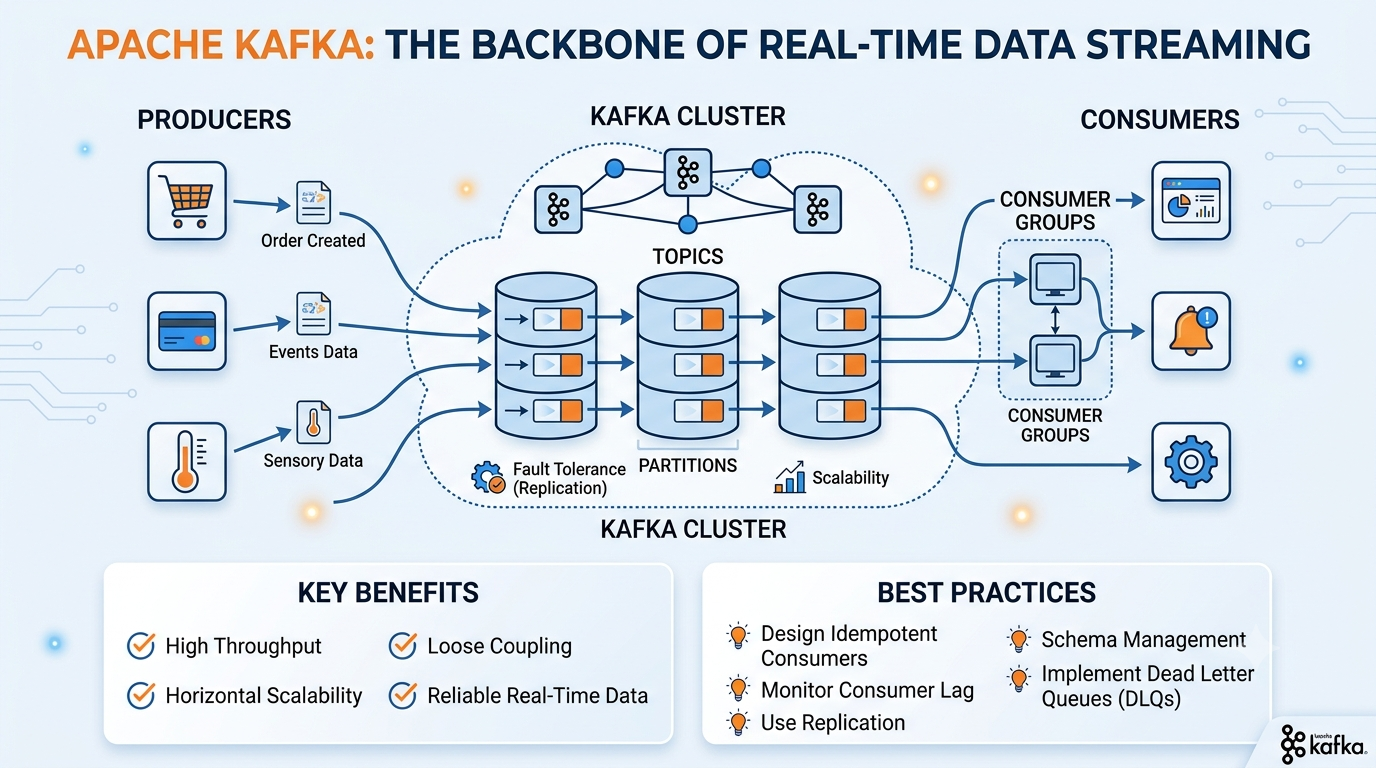
Apache Kafka is an open-source distributed event streaming platform designed for high-throughput, fault-tolerant, and scalable data streaming. Instead of one service calling another directly, applications publish events to Kafka, and interested services consume those events independently.
Core Components
- Producer: Publishes events to Kafka topics.
- Broker: Stores and manages events in a Kafka cluster.
- Topic: A logical category that organizes related events.
- Partition: Splits a topic for parallel processing and scalability.
- Consumer: Reads and processes events.
- Consumer Group: Distributes partitions across multiple consumers for efficient processing.
How Kafka Works
When an order is placed, the Order Service publishes an "Order Created" event. Kafka stores the event in the Orders topic. Payment, Inventory, Notification, and Analytics services each subscribe to the topic and process the event independently. This architecture reduces service dependencies and improves scalability.
Fault Tolerance
Kafka replicates partitions across multiple brokers. If the leader broker fails, a follower automatically becomes the new leader. Consumers track their reading position using offsets, allowing them to resume processing after failures without starting over.
Best Practices
- Keep events focused and lightweight.
- Build idempotent consumers to safely handle retries.
- Monitor consumer lag and cluster health.
- Configure replication and retention based on business requirements.
- Use schema management for message compatibility.
- Secure communication with authentication and encryption.
- Handle failed messages with Dead Letter Queues.
Common Use Cases
- Event-driven microservices
- Real-time analytics
- Payment processing
- Inventory management
- Notification systems
- User activity tracking
- IoT event streaming
- Centralized log collection
Conclusion
Apache Kafka has become a core technology for building scalable, resilient, and event-driven systems. By decoupling services and enabling reliable event streaming, Kafka helps organizations create applications that can grow without sacrificing performance or reliability.
Whether you're building with PHP, Laravel, Java, or another platform, understanding Kafka is an essential skill for modern backend developers and software architects.