
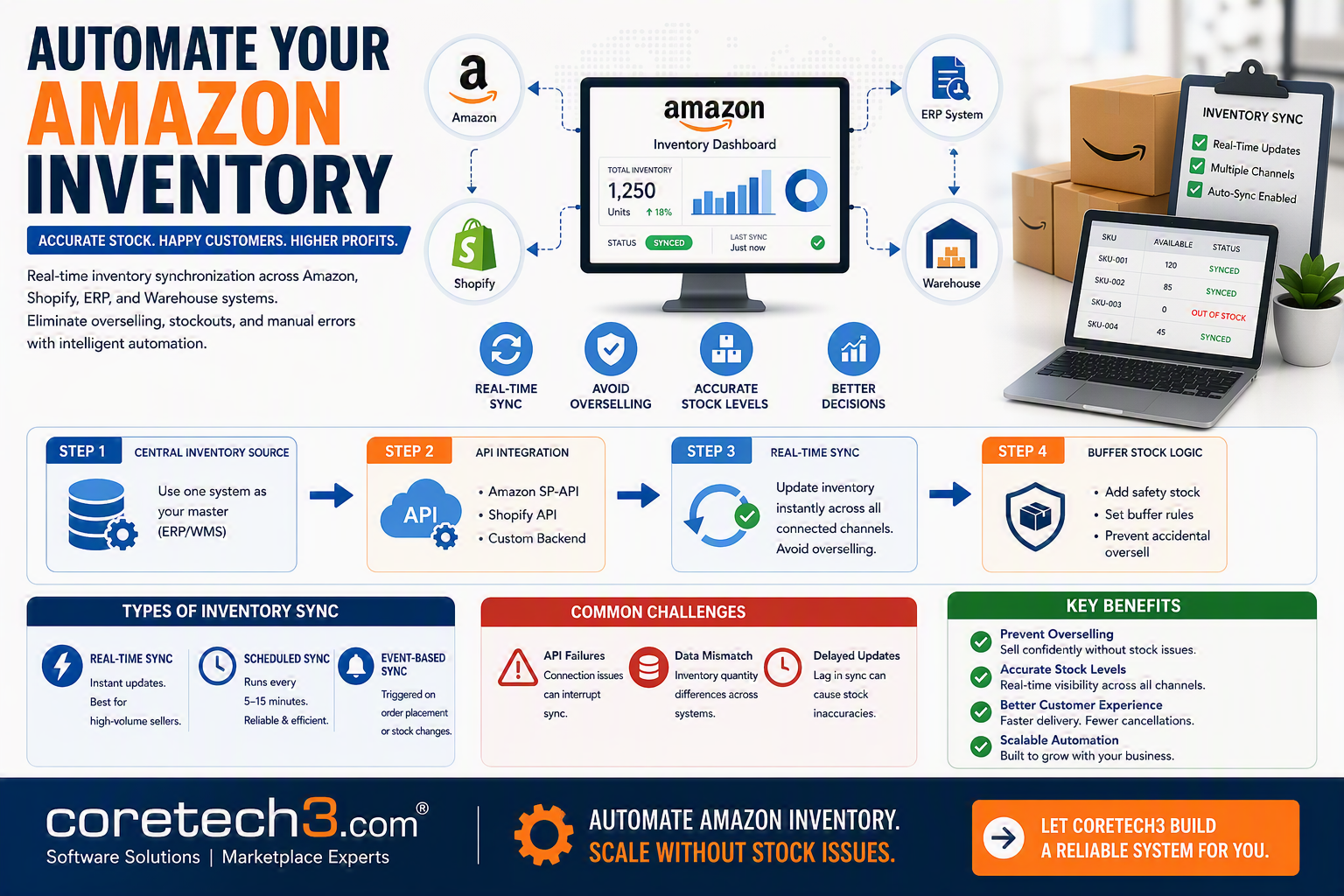
Automate Amazon Inventory Sync: The Complete Guide
Introduction
For growing eCommerce businesses, inventory accuracy is one of the most critical factors in maintaining profitability and customer satisfaction. Whether you sell on Amazon, Shopify, or multiple online marketplaces, managing inventory manually becomes increasingly difficult as your business scales.
Poor inventory management often results in overselling, stock shortages, delayed shipments, canceled orders, and dissatisfied customers. These issues not only affect revenue but also impact seller performance and brand reputation.
The good news is that Inventory Synchronization Automation can solve these challenges by ensuring stock levels remain accurate across all connected systems in real time.
In this guide, we'll explore how Amazon Inventory Sync works, why automation is essential, and how businesses can build a scalable inventory management system using Amazon SP-API.
What is Inventory Synchronization?
Inventory synchronization (Inventory Sync) is the process of automatically updating product stock levels across multiple platforms whenever inventory changes.
Instead of manually updating inventory on each platform, automation ensures every connected system reflects the latest stock quantity.
Typical systems involved include:
- Amazon Marketplace
- Shopify Stores
- Warehouse Management Systems (WMS)
- Enterprise Resource Planning (ERP) Systems
- Third-Party Logistics (3PL) Providers
- Custom Business Applications
When inventory changes in one system, the update is immediately synchronized across all connected platforms.
This creates a single, reliable source of truth for inventory management.
Why Inventory Automation Matters
Without automation, businesses commonly face several operational challenges.
1. Increased Manual Errors
Manual inventory updates are time-consuming and highly prone to mistakes.
Even a small error can create major inventory discrepancies across sales channels.
2. Overselling Products
When inventory isn't updated quickly, products may continue selling even after stock reaches zero.
This leads to:
- Order cancellations
- Negative customer reviews
- Lower Amazon seller ratings
3. Stockouts and Lost Revenue
Inaccurate inventory can also hide available stock, causing businesses to miss potential sales opportunities.
4. Poor Customer Experience
Customers expect fast shipping and accurate product availability.
Inventory errors often result in:
- Delayed shipments
- Backorders
- Refund requests
- Reduced customer trust
5. Limited Business Scalability
Managing hundreds or thousands of SKUs manually becomes nearly impossible as order volume increases.
Automation allows businesses to scale without increasing operational complexity.
How Amazon Inventory Automation Works
Step 1: Establish a Central Inventory Source
Choose one system to serve as the master inventory database.
Common choices include:
- ERP System
- Warehouse Management System (WMS)
- Inventory Management Software
This becomes the single source of truth for all inventory updates.
Step 2: Connect Systems Using APIs
Modern inventory automation relies on API integrations.
Popular integrations include:
Amazon SP-API
Synchronizes:
- Inventory
- Orders
- Listings
- Fulfillment Data
Shopify API
Keeps Shopify inventory aligned with Amazon inventory.
Custom Backend Integrations
Connect additional systems such as:
- ERP
- WMS
- Supplier Systems
- Accounting Software
- Fulfillment Providers
Step 3: Enable Real-Time Inventory Synchronization
Whenever inventory changes due to:
- Customer Orders
- Warehouse Receipts
- Product Returns
- Manual Adjustments
- Stock Transfers
The updated quantity is automatically pushed to every connected sales channel.
Benefits include:
- Accurate inventory visibility
- Faster order processing
- Reduced manual effort
- Prevention of overselling
Step 4: Implement Buffer Stock Logic
Buffer stock helps prevent accidental overselling.
Example
Physical Inventory: 100 Units
Safety Buffer: 10 Units
Available for Sale: 90 Units
This strategy provides additional protection against:
- Fulfillment delays
- Warehouse counting errors
- High sales velocity
- Inventory discrepancies
Types of Inventory Synchronization
Real-Time Inventory Sync
Inventory updates occur instantly after stock changes.
Best For
- High-volume Amazon sellers
- Multi-channel businesses
- Fast-moving inventories
Advantages
- Maximum inventory accuracy
- Lowest overselling risk
- Excellent customer experience
Scheduled Inventory Sync
Inventory updates occur at predefined intervals such as:
- Every 5 minutes
- Every 10 minutes
- Every 15 minutes
Best For
- Medium-volume businesses
- Cost-sensitive integrations
Event-Based Synchronization
Updates occur only when specific business events happen.
Examples include:
- New Orders
- Returns
- Warehouse Updates
- Inventory Adjustments
Best For
- Automated fulfillment systems
- Enterprise integrations
- Custom workflows
Common Inventory Synchronization Challenges
Even automated systems require proper architecture.
Common challenges include:
API Failures
Temporary API outages may interrupt synchronization.
A robust solution should include:
- Retry mechanisms
- Error logging
- Automatic recovery
Data Mismatches
Inventory values may differ across systems due to delayed updates or manual modifications.
Regular reconciliation processes help maintain consistency.
Synchronization Delays
Network latency or API rate limits can slow inventory updates.
Optimized integrations reduce these delays significantly.
Scaling Challenges
As businesses grow, order volume and system complexity increase.
Scalable cloud-based architectures help maintain high performance during peak sales periods.
Best Practices for Amazon Inventory Automation
To build a reliable inventory synchronization system:
- Use a single source of truth for inventory.
- Integrate systems through secure APIs.
- Enable real-time synchronization whenever possible.
- Implement intelligent buffer stock logic.
- Monitor API failures and retry automatically.
- Schedule regular inventory reconciliation.
- Maintain detailed audit logs for inventory changes.
- Design scalable architecture for future business growth.
How Coretech3 Helps
At Coretech3, we develop enterprise-grade inventory automation solutions tailored for modern eCommerce businesses.
Our expertise includes:
Real-Time Inventory Synchronization
Synchronize inventory instantly across Amazon and multiple sales channels.
Amazon SP-API Integration
Build secure, scalable integrations using Amazon's latest APIs.
Multi-Channel Inventory Management
Connect:
- Amazon
- Shopify
- ERP Systems
- WMS Platforms
- Fulfillment Providers
Custom Business Logic
Implement advanced inventory rules including:
- Buffer stock management
- Warehouse prioritization
- Inventory allocation
- Safety stock calculation
Scalable Automation Pipelines
Our solutions are designed to support businesses as order volume grows without sacrificing performance or accuracy.
Ongoing Support & Optimization
We continuously monitor, maintain, and optimize inventory integrations to ensure long-term reliability.
Final Thoughts
Inventory synchronization is no longer a luxury—it's a necessity for modern eCommerce businesses.
Automating inventory updates helps eliminate manual errors, prevent overselling, improve customer satisfaction, and create a scalable foundation for future growth.
By leveraging Amazon SP-API and custom automation workflows, businesses can build a reliable inventory ecosystem that supports long-term success.
Whether you're managing hundreds or hundreds of thousands of products, investing in inventory automation is one of the smartest decisions you can make for your business.
Ready to Automate Your Amazon Inventory?
If you're looking to eliminate manual inventory management and build a scalable, real-time synchronization system, Coretech3 is here to help.
Our experts specialize in Amazon SP-API integrations, multi-channel inventory automation, ERP connectivity, and custom business workflows designed specifically for growing eCommerce businesses.
Contact Coretech3 today to discuss your inventory automation requirements and discover how we can help streamline your operations and accelerate your business growth.