The industrial landscape is undergoing a remarkable transformation. While Industry 4.0 introduced automation, connectivity, and intelligent systems into manufacturing, Industry 5.0 is taking the next step by placing humans back at the center of innovation. Together, these industrial revolutions are reshaping how businesses operate, compete, and create value.
Understanding Industry 4.0 Industry 4.0, often referred to as the Fourth Industrial Revolution, emerged with the integration of digital technologies into manufacturing and industrial processes. Its primary goal is to create "smart factories" where machines, systems, and devices communicate seamlessly through interconnected networks.
Key technologies driving Industry 4.0 include:
Internet of Things (IoT) Artificial Intelligence (AI) Machine Learning (ML) Cloud Computing Big Data Analytics Robotics and Automation Digital Twins Cyber-Physical Systems Through these technologies, organizations can collect real-time data, optimize production, predict equipment failures, and improve operational efficiency. Industry 4.0 focuses heavily on productivity, automation, and cost reduction.
Benefits of Industry 4.0 ✅ Enhanced operational efficiency
✅ Reduced downtime through predictive maintenance
✅ Improved product quality
✅ Faster decision-making using real-time data
✅ Increased production flexibility
However, Industry 4.0 has often been criticized for prioritizing automation over human involvement, leading to concerns about workforce displacement and reduced human interaction in industrial processes.
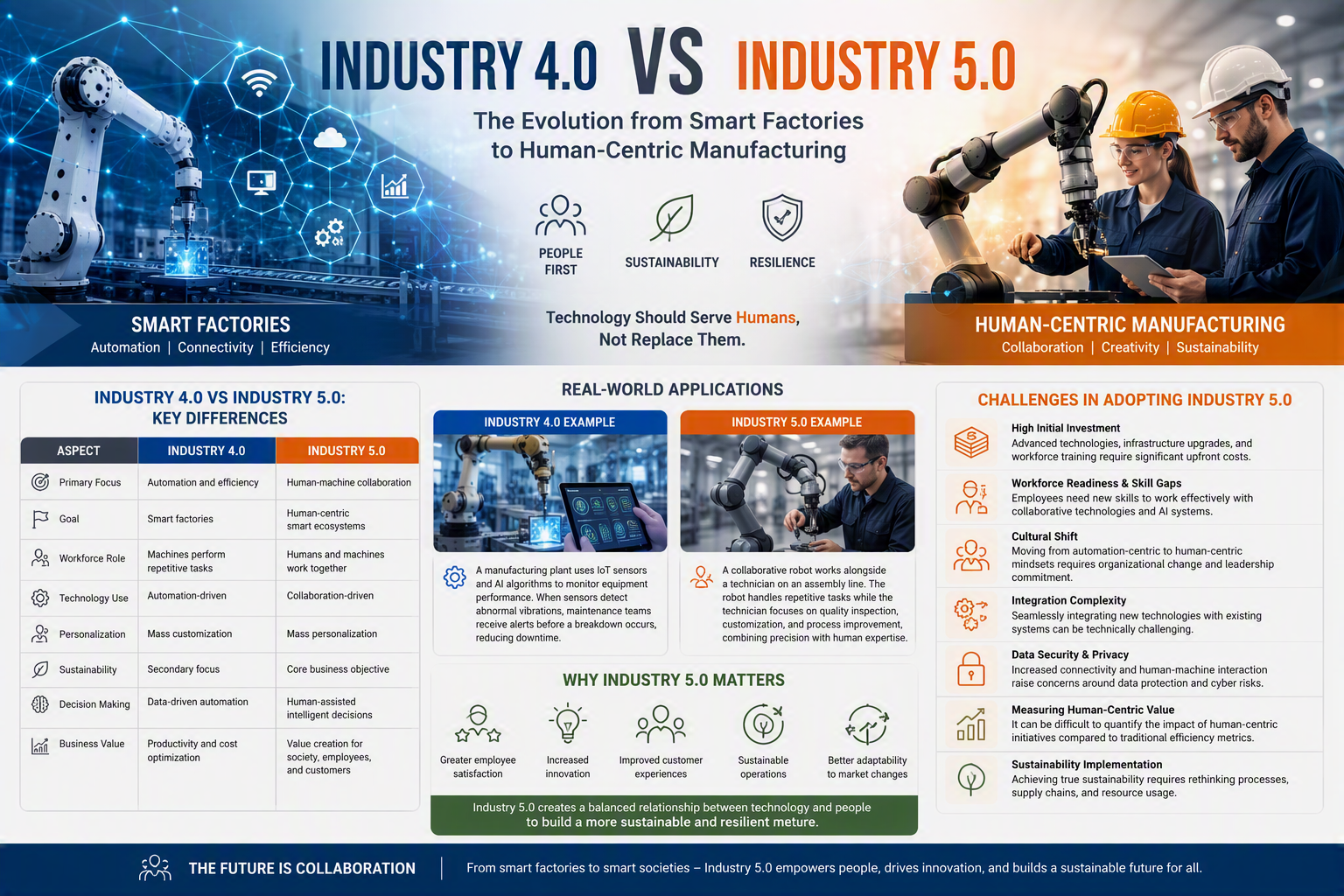
Understanding Industry 5.0 Industry 5.0 represents the next phase of industrial evolution. Rather than replacing humans with machines, it emphasizes collaboration between human creativity and intelligent technologies.
The philosophy behind Industry 5.0 is simple:
Technology should serve humans, not replace them.
Industry 5.0 focuses on three core pillars:
-
Human-Centric Approach Employees are viewed as valuable assets whose creativity, problem-solving abilities, and expertise complement advanced technologies.
-
Sustainability Organizations are encouraged to minimize environmental impact through energy-efficient processes, resource optimization, and circular economy principles.
-
Resilience Businesses are designed to adapt quickly to disruptions such as supply chain challenges, economic uncertainty, or global crises.
Advanced collaborative robots (cobots), AI-assisted decision-making, and personalized manufacturing solutions are key characteristics of Industry 5.0.
Industry 4.0 vs Industry 5.0: Key Differences Aspect Industry 4.0 Industry 5.0 Primary Focus Automation and efficiency Human-machine collaboration Goal Smart factories Human-centric smart ecosystems Workforce Role Machines perform repetitive tasks Humans and machines work together Technology Use Automation-driven Collaboration-driven Personalization Mass customization Mass personalization Sustainability Secondary focus Core business objective Decision Making Data-driven automation Human-assisted intelligent decisions Business Value Productivity and cost optimization Value creation for society, employees, and customers Real-World Applications Industry 4.0 Example A manufacturing plant uses IoT sensors and AI algorithms to monitor equipment performance. When sensors detect abnormal vibrations, maintenance teams receive alerts before a breakdown occurs, reducing downtime.
Industry 5.0 Example A collaborative robot works alongside a technician on an assembly line. The robot handles repetitive tasks while the technician focuses on quality inspection, customization, and process improvement, combining precision with human expertise.
Why Industry 5.0 Matters Today's customers demand personalized products, sustainable business practices, and ethical innovation. Industry 5.0 responds to these expectations by creating a balanced relationship between technology and people.
Organizations adopting Industry 5.0 can achieve:
Greater employee satisfaction Increased innovation Improved customer experiences Sustainable operations Better adaptability to market changes Rather than replacing the advancements of Industry 4.0, Industry 5.0 builds upon them and adds a human dimension that drives long-term business success.
Challenges in Adopting Industry 5.0 While Industry 5.0 offers significant benefits through human-machine collaboration, sustainability, and resilience, organizations often face several challenges during implementation.
-
High Initial Investment Transitioning to Industry 5.0 requires substantial investment in advanced technologies, collaborative robots (cobots), AI platforms, training programs, and digital infrastructure. For many organizations, especially small and medium-sized enterprises (SMEs), these costs can be a major barrier.
-
Workforce Skill Gaps Industry 5.0 demands new skills that combine technical expertise with human-centered problem-solving. Employees must learn to work alongside AI systems, robotics, and digital tools, making continuous upskilling and reskilling essential.
-
Cultural and Organizational Change Moving from a traditional automation-focused mindset to a human-centric approach requires significant cultural transformation. Leadership teams must foster collaboration, innovation, and employee engagement to ensure successful adoption.
-
Integration with Legacy Systems Many organizations still rely on older manufacturing and enterprise systems. Integrating modern Industry 5.0 technologies with existing infrastructure can be technically complex, time-consuming, and costly.
-
Data Security and Privacy Concerns Greater connectivity between humans, machines, and digital platforms increases the risk of cyberattacks and data breaches. Organizations must strengthen cybersecurity measures to protect sensitive operational and employee data.
-
Measuring Human-Centric Value Unlike Industry 4.0, where success is often measured through productivity and efficiency metrics, Industry 5.0 also focuses on employee well-being, innovation, and societal impact. Quantifying these benefits can be difficult.
-
Sustainability Implementation Challenges Industry 5.0 emphasizes environmental responsibility, but achieving sustainability goals often requires redesigning processes, supply chains, and resource management practices, which can be complex and resource-intensive.
-
Balancing Human Expertise and Automation Organizations must determine the optimal balance between machine efficiency and human creativity. Over-automation can undermine Industry 5.0 principles, while underutilization of technology can limit potential benefits.
Key Takeaway The journey to Industry 5.0 is not merely a technology upgrade; it is a transformation of people, processes, and culture. Organizations that successfully address these challenges can create more resilient, sustainable, and innovative workplaces where humans and intelligent machines work together to drive future growth. 🚀
Conclusion Industry 4.0 revolutionized manufacturing through automation, data analytics, and connected systems, enabling organizations to achieve unprecedented efficiency. Industry 5.0 takes this transformation further by integrating human creativity, sustainability, and resilience into industrial operations.
The future of manufacturing is not about humans versus machines. It is about humans and machines working together to create smarter, more sustainable, and more innovative industries. Organizations that embrace this collaborative approach will be better positioned to thrive in the evolving digital economy.
The journey from Industry 4.0 to Industry 5.0 marks a shift from smart factories to smart societies, where technology empowers people and drives sustainable growth.