
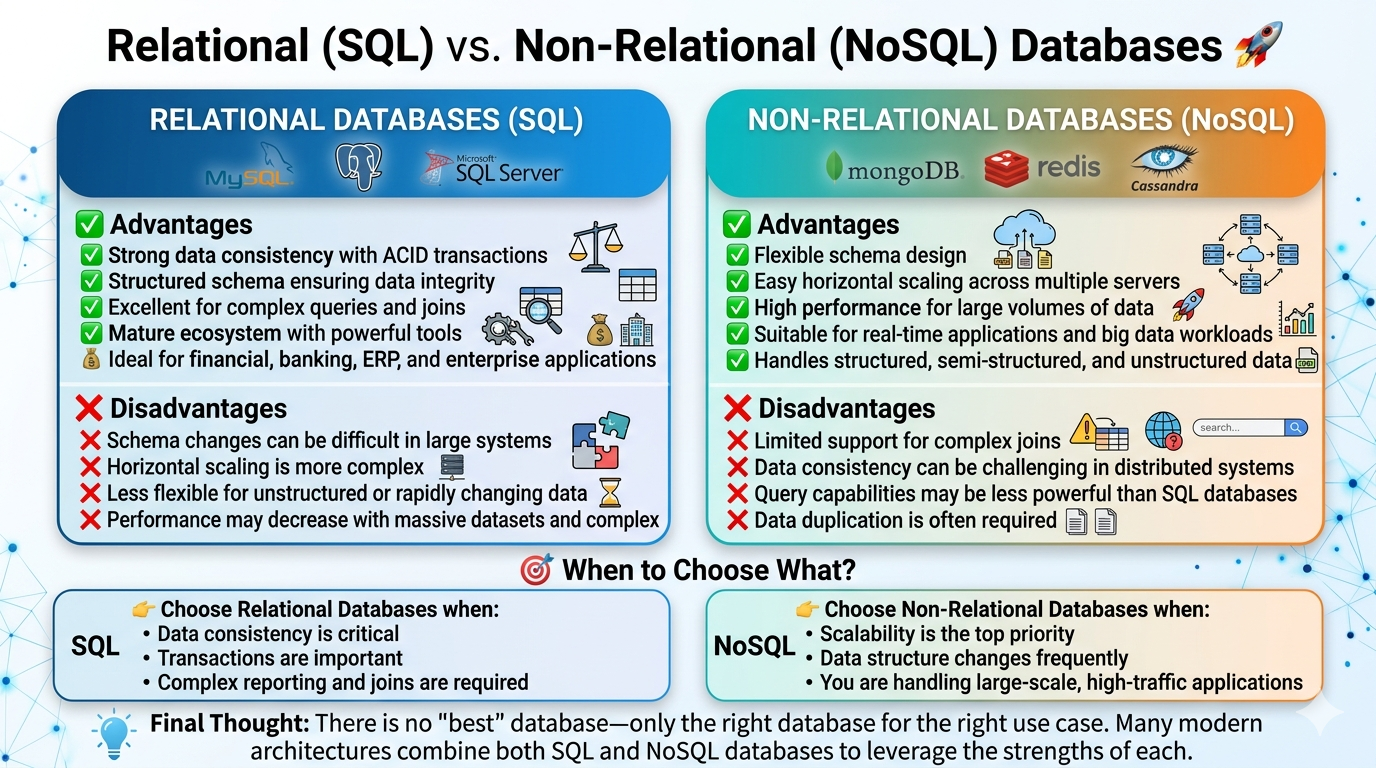
Choosing the right database is one of the most important decisions when designing an application. Let's compare Relational (SQL) and Non-Relational (NoSQL) databases.
Relational Databases (SQL)
Examples: MySQL, PostgreSQL, Microsoft SQL Server
�
Advantages
- Strong data consistency with ACID transactions
- Structured schema ensures data integrity
- Excellent for complex queries and joins
- Mature ecosystem with powerful tools
- Ideal for financial, banking, ERP, and enterprise applications
Disadvantages
- Schema changes can be difficult in large systems
- Horizontal scaling is more complex
- Less flexible for unstructured or rapidly changing data
- Performance may decrease with massive datasets and complex joins
Non-Relational Databases (NoSQL)
Examples: MongoDB, Redis, Apache Cassandra
�
Advantages
- Flexible schema design
- Easy horizontal scaling across multiple servers
- High performance for large volumes of data
- Suitable for real-time applications and big data workloads
- Handles structured, semi-structured, and unstructured data
Disadvantages
- Limited support for complex joins
- Data consistency can be challenging in distributed systems
- Query capabilities may be less powerful than SQL databases
- Data duplication is often required
When to Choose What?
Choose Relational Databases when:
Data consistency is critical
Transactions are important
Complex reporting and joins are required
Choose Non-Relational Databases when:
Scalability is the top priority
Data structure changes frequently
You are handling large-scale, high-traffic applications
Final Thought
There is no "best" database—only the right database for the right use case.
Many modern architectures combine both SQL and NoSQL databases to leverage the strengths of each.
What's your preferred database for production applications and why? 👇
#Database #SQL #NoSQL #MySQL #PostgreSQL #MongoDB #Redis #SystemDesign #BackendDevelopment #SoftwareEngineering #WebDevelopment #TechLeadership #Programming #Developers #LinkedInPost