
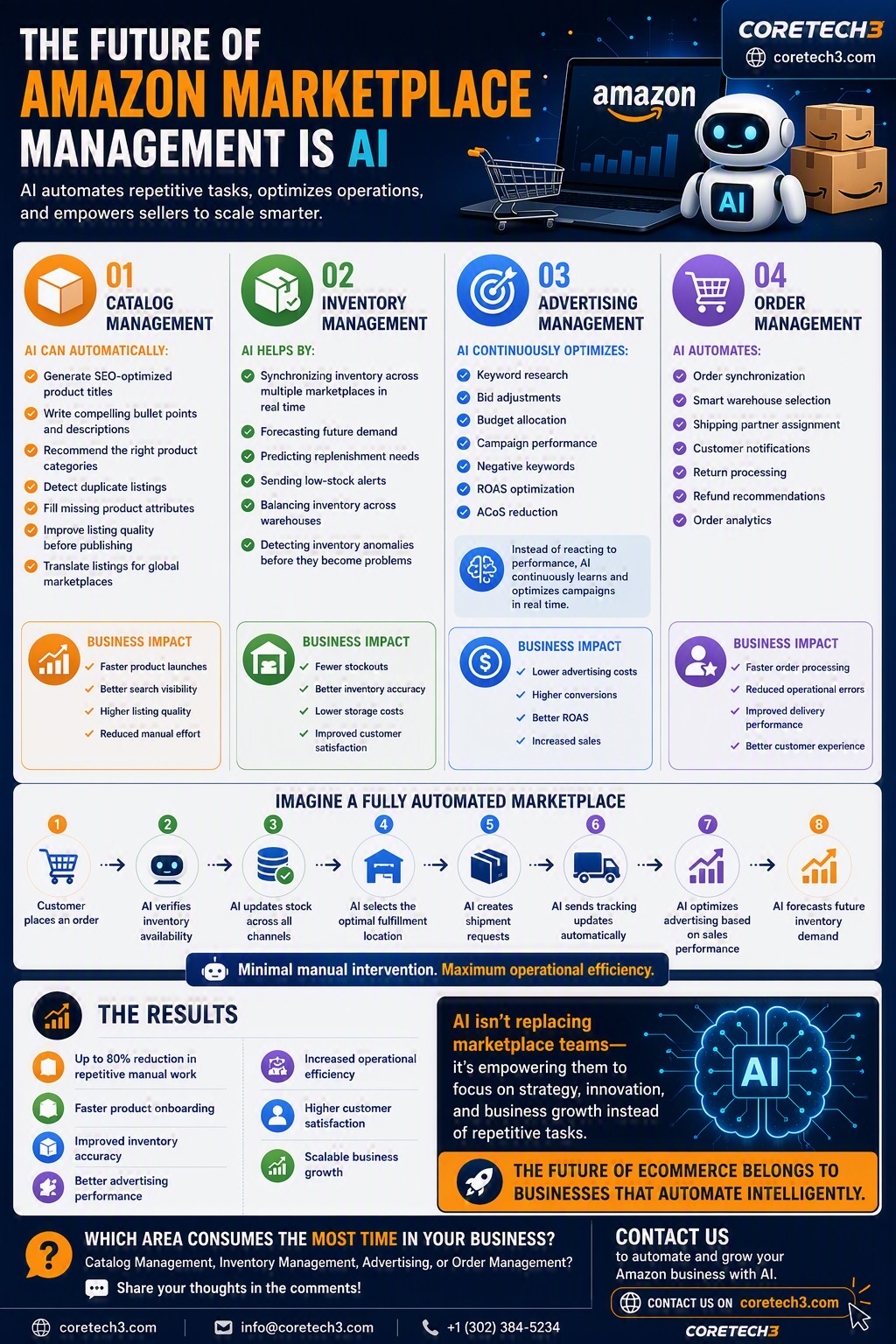
🚀 The Future of Amazon Marketplace Management is AI
Managing an Amazon Seller account isn't just about listing products anymore. As your business grows, so do the operational challenges.
Every day, sellers spend countless hours managing four critical areas:
📦 Catalog Management 📊 Inventory Management 🎯 Advertising Management 🛒 Order Management
The real question is:
How much of this work can AI automate?
The answer: Almost all repetitive operational tasks.
Here's how AI is transforming each component of marketplace management.
📦 1. Catalog Management
Managing thousands of products manually is no longer sustainable.
AI can automatically: ✅ Generate SEO-optimized product titles ✅ Write compelling bullet points and descriptions ✅ Recommend the right product categories ✅ Detect duplicate listings ✅ Fill missing product attributes ✅ Improve listing quality before publishing ✅ Translate listings for global marketplaces
Business Impact ✔ Faster product launches ✔ Better search visibility ✔ Higher listing quality ✔ Reduced manual effort
📊 2. Inventory Management
Inventory errors lead to overselling, stockouts, canceled orders, and unhappy customers.
AI helps by: ✅ Synchronizing inventory across multiple marketplaces in real time ✅ Forecasting future demand ✅ Predicting replenishment needs ✅ Sending low-stock alerts ✅ Balancing inventory across warehouses ✅ Detecting inventory anomalies before they become problems
Business Impact ✔ Fewer stockouts ✔ Better inventory accuracy ✔ Lower storage costs ✔ Improved customer satisfaction
🎯 3. Advertising Management
Managing Amazon Ads manually can quickly become overwhelming.
AI continuously optimizes: ✅ Keyword research ✅ Bid adjustments ✅ Budget allocation ✅ Campaign performance ✅ Negative keywords ✅ ROAS optimization ✅ ACoS reduction
Instead of reacting to performance, AI continuously learns and optimizes campaigns in real time.
Business Impact ✔ Lower advertising costs ✔ Higher conversions ✔ Better Return on Ad Spend (ROAS) ✔ Increased sales
🛒 4. Order Management
From the moment an order is placed until it's delivered, AI can automate nearly every step.
AI automates: ✅ Order synchronization ✅ Smart warehouse selection ✅ Shipping partner assignment ✅ Customer notifications ✅ Return processing ✅ Refund recommendations ✅ Order analytics
Business Impact ✔ Faster order processing ✔ Reduced operational errors ✔ Improved delivery performance ✔ Better customer experience
🔄 Imagine a Fully Automated Marketplace
Customer places an order ⬇️
🤖 AI verifies inventory ⬇️ 🤖 Updates stock across all channels ⬇️ 🤖 Selects the nearest warehouse ⬇️ 🤖 Creates the shipment ⬇️ 🤖 Updates tracking automatically ⬇️ 🤖 Optimizes advertising based on sales performance ⬇️ 🤖 Forecasts future inventory demand
Minimal manual intervention. Maximum operational efficiency.
📈 The Results
✔ Up to 80% reduction in repetitive manual work ✔ Improved inventory accuracy ✔ Faster product onboarding ✔ Better advertising performance ✔ Increased operational efficiency ✔ Higher customer satisfaction ✔ Scalable business growth
AI isn't replacing marketplace teams—it's empowering them to focus on strategy, innovation, and business growth instead of repetitive tasks.
The future of eCommerce belongs to businesses that automate intelligently.
💬 Which marketplace operation consumes the most time in your business—Catalog, Inventory, Advertising, or Orders? Share your thoughts in the comments!
#Amazon #AmazonSeller #Marketplace #ArtificialIntelligence #Automation #AmazonFBA #AmazonFBM #InventoryManagement #Advertising #OrderManagement #CatalogManagement #eCommerce #SupplyChain #DigitalTransformation #BusinessAutomation #AI