
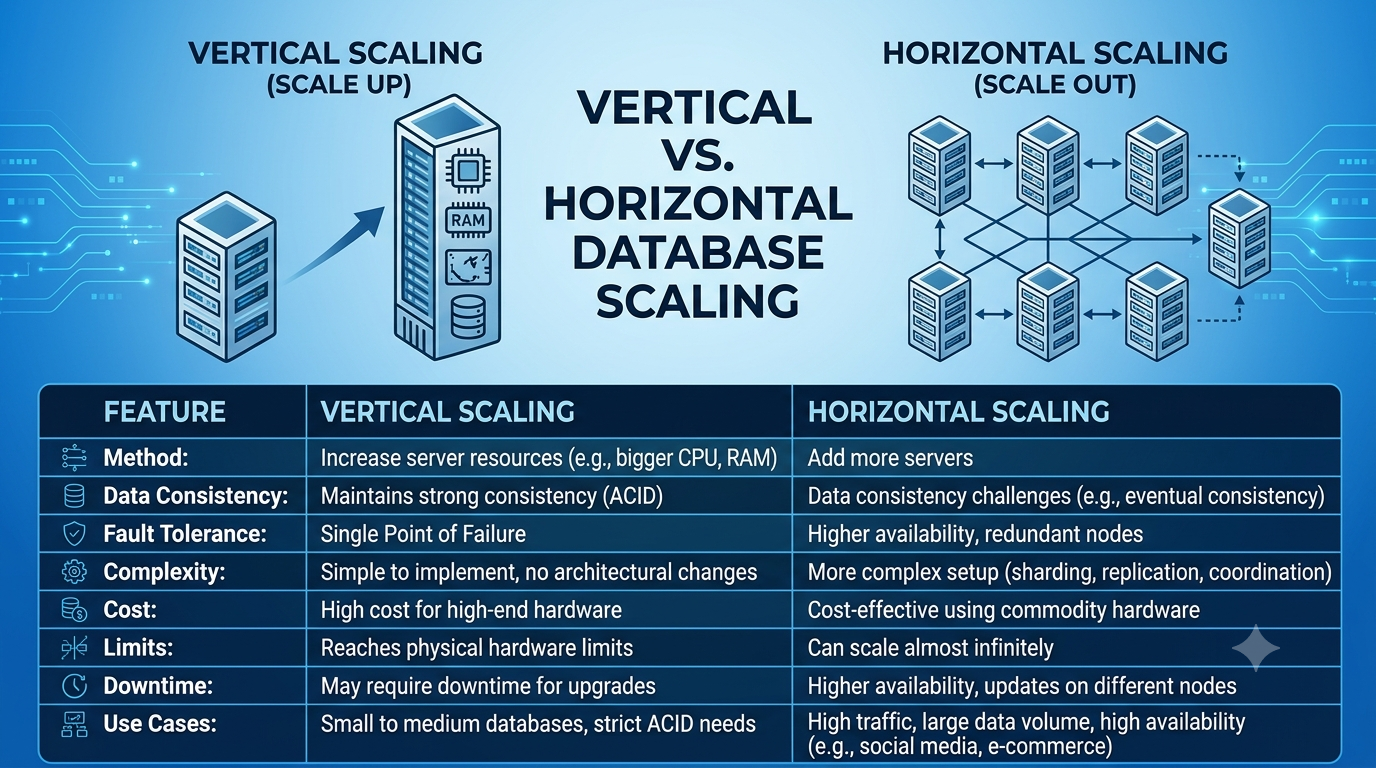
As applications grow, database performance becomes a critical challenge. Two common approaches to handle increasing traffic and data volume are Vertical Scaling and Horizontal Scaling.
Vertical Scaling (Scale Up)
Vertical scaling means increasing the resources of a single database server.
Examples:
Upgrade CPU from 4 cores to 16 cores
Increase RAM from 16GB to 64GB
Move from HDD to SSD/NVMe storage
Advantages:
�
Easy to implement
�
No application architecture changes required
�
Simple database management
�
Strong consistency maintained
Disadvantages:
- Hardware has limits
- Expensive at higher levels
- Single point of failure
- Downtime may be required during upgrades
Use Cases:
Small to medium-sized applications
Startups in early growth stages
Systems requiring strong ACID compliance
Horizontal Scaling (Scale Out)
Horizontal scaling means adding more database servers and distributing data or traffic across them.
Examples:
Adding read replicas
Database sharding
Distributed databases
Multi-node clusters
Advantages:
�
Handles massive traffic and data growth
�
Improved availability and fault tolerance
�
Better load distribution
�
Can scale almost infinitely
Disadvantages:
- More complex architecture
- Data consistency challenges
- Sharding complexity
- Higher operational overhead
Use Cases:
High-traffic applications
E-commerce platforms
Social media applications
SaaS products with millions of users
📊 Comparison
Feature Vertical Scaling Horizontal Scaling
Method Add more resources to one server Add more servers
Cost High-end hardware is expensive Commodity servers can be used
Complexity Low High
Scalability Limit Limited Nearly unlimited
Availability Lower Higher
Performance Good for moderate workloads Excellent for large workloads
Real-World Examples
MySQL Read Replicas → Horizontal Scaling
PostgreSQL Server Upgrade → Vertical Scaling
Amazon Database Sharding → Horizontal Scaling
Netflix Distributed Databases → Horizontal Scaling
Key Takeaway 🎯
Vertical Scaling = Buy a Bigger Machine
Horizontal Scaling = Add More Machines
Most successful systems start with Vertical Scaling because it is simple. As traffic grows significantly, they adopt Horizontal Scaling to achieve better performance, reliability, and scalability.
#Database #SystemDesign #BackendDevelopment #SoftwareEngineering #MySQL #PostgreSQL #Scalability #DistributedSystems #WebDevelopment #TechLeadership #Engineering #LinkedInLearning