
Inventory, orders, catalog, pricing, reports, and notifications—wired securely into your ERP, WMS, data warehouse, or internal tools. Built for uptime, rate limits, and long-term maintenance.
Auth, data & reporting
Monitoring & alerts
Automation coverage

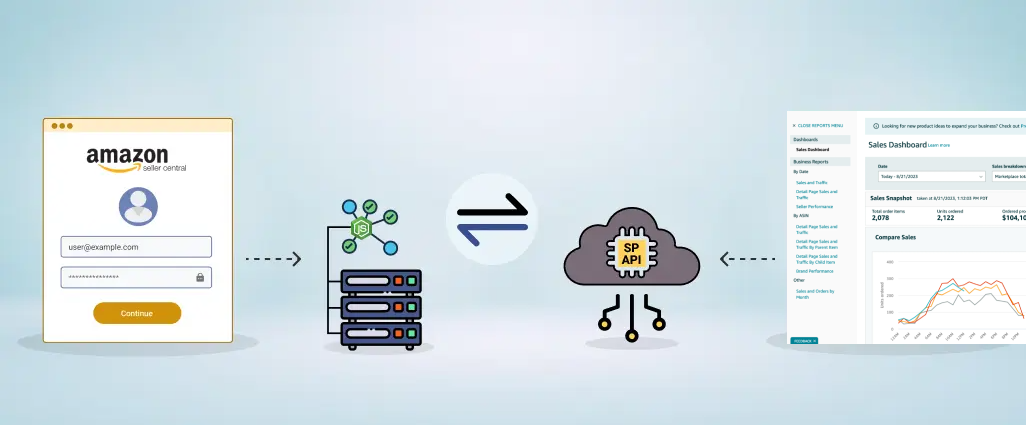
Selling Partner API (SP-API) is Amazon’s modern REST-based surface for programmatic access to orders, inventory, listings, pricing, reports, and operational data. It succeeds legacy MWS with clearer auth models, granular roles, and APIs aligned to how sellers operate today.
Practically, SP-API lets you automate reconciliation, fulfillment workflows, catalog updates, and analytics—while keeping security and compliance aligned with Amazon’s expectations.
Orchestrate orders, inventory, shipments, and notifications with idempotent jobs, retries, and observability.
Pull structured reports and feeds into your warehouse or dashboards for finance, ops, and growth teams.
Connect Seller Central data to ERP, WMS, OMS, or custom apps using stable contracts and documented runbooks.
Focused engagement models—from tactical integrations to fully managed automation platforms.

Ingest orders, track statuses, and coordinate fulfillment with dependable polling and notification handling.

Keep stock positions truthful across channels with disciplined sync windows and exception handling.

Implement repricing and guardrails that respect margin floors and marketplace policies.

Bulk listing workflows, content updates, and variation maintenance with validation upfront.

Pair marketplace ops with advertising data where it matters—often alongside our Advertising API work.

Automate report requests, parse outputs, and land clean datasets for finance and leadership.
Representative areas—your build may combine multiple APIs, queues, and data stores.
We ship integrations that survive peak events: backoff strategies, structured logging, alerting, and documentation your team can operate. Engagements range from targeted APIs to multi-workstream automation programs.
Reuse proven patterns for auth, token rotation, sandbox validation, and production cutover—without sacrificing your edge cases.
Least-privilege roles, secret hygiene, and operational guardrails aligned with how Amazon expects SP-API clients to behave.
Less manual reconciliation and fewer spreadsheet bridges.
One operational truth flowing to finance and ops.
Architectures that tolerate spikes and growing SKU counts.
Timely metrics instead of stale exports.
Automation amortizes engineering across volume.
React faster on inventory, pricing, and fulfillment.
Transparent phases—from discovery through hypercare—so stakeholders always know what ships next.
Map workflows, systems, data contracts, SLAs, and compliance constraints.
Register developer assets, roles, redirect URIs, and token lifecycle handling.
Implement APIs, queues, stores, and internal UX with code review and observability.
Exercise edge cases, backoff paths, and reconciliation checks before production traffic.
Progressive rollout, monitoring, and rollback plans aligned with your ops cadence.
Maintenance windows, dependency upgrades, and iterative enhancements.
If you still depend on legacy MWS endpoints, we map functional parity, refactor authentication, and validate feeds and reports under SP-API—minimizing downtime and surprises during cutover.
Dual-running where practical, with reconciliation checkpoints between systems.
Adopt newer primitives where they simplify operations—without boiling the ocean.
Easier to integrate with contemporary services and observability stacks.
OAuth flows and constrained roles reduce accidental exposure.
Features and datasets not exposed via legacy surfaces.
Better alignment with Amazon’s platform roadmap and notices.
Stay aligned as marketplace requirements evolve.
Tell us about your catalog size, marketplaces, internal systems, and SLAs—we’ll propose an architecture and milestone plan that fits how your team actually ships.